The Smokies, explained for Pittsburghers
Why are the Smoky Mountains smoky?
It isn't smoke, and it isn't smog. Here is the science, how the Smokies stack up against Pennsylvania's highest ground, and how much colder it gets at the top.
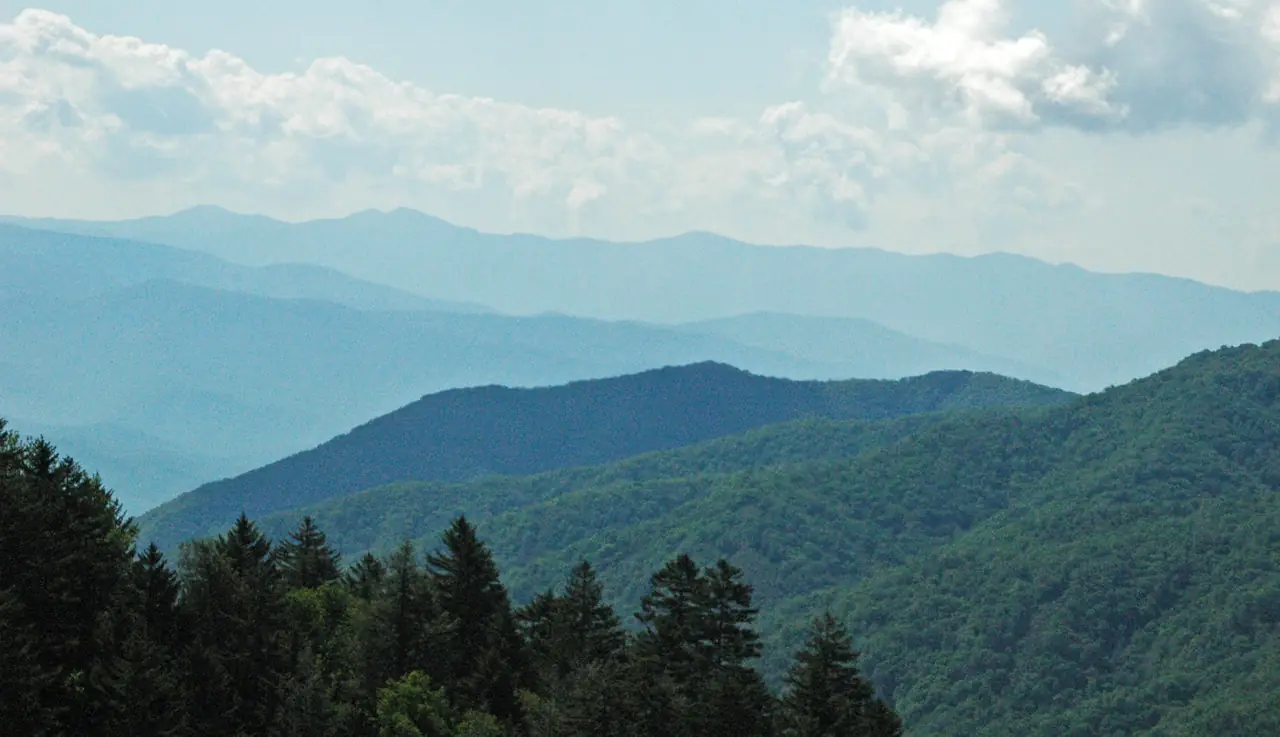
Photo: James St. John, CC BY 2.0 / Wikimedia Commons
Short answer
The "smoke" is made by the forest. Plants give off volatile organic compounds that form tiny particles, and those scatter blue light, says the National Park Service; the park is named for the mists that rise like smoke. The Smokies are part of the Appalachians, among the oldest mountains on Earth, and top out at Kuwohi, 6,643 feet, about twice Pennsylvania's highest point, Mount Davis (3,213 feet).
Interactive
How high, and how cold up top
Normal July high, Gatlinburg (1,454 ft)
Normal July high, Mount Le Conte (6,493 ft)
Pittsburgh's normal July high at its airport is 83°F.
Orange bars are in or near the national park. Heights: NPS (Kuwohi, park low point), NC State Parks (Mount Mitchell), Pennsylvania DCNR and USGS (Mount Davis, Pittsburgh). Weather station heights and temperatures: NOAA 1991-2020 normals for Gatlinburg 2 SW and Mt. Le Conte.
Visual
The Smokies in numbers
Reading the view
Blue haze or smog?
The natural blue
Forest plants emit volatile organic compounds, the primary reason for the famous blue haze. The particles scatter shorter blue wavelengths of sunlight (NPS).
Rising mist
The park takes its name from the mists that often rise like smoke from the mountains (NPS).
Pollution haze
Air pollution shows up differently, as a uniform whitish haze, according to the park's air quality page.
Pittsburgh to the Appalachians' tallest ridges: a full day by car, or about 78 minutes in the air if the nonstop existed.
… travelers have pledged · about … round trips a year
Add your pledge →Questions
Why are the Smoky Mountains smoky?
Are the Smoky Mountains part of the Appalachian Mountains?
Are the Smoky Mountains in Pennsylvania?
How tall are the Smoky Mountains?
How much colder is it on top of the Smokies?
Sources
- NPS: Where the mountains breathe (updated Jan 28, 2026)
- NPS: Great Smoky Mountains National Park (updated Sept 30, 2026)
- NPS: air quality
- NPS: Great Smoky Mountains, mountains (updated May 8, 2025)
- NPS: park statistics (updated June 2, 2025)
- NPS: natural features and ecosystems
- NPS: 2025 visitation statistics (Mar 13, 2026)
- NPS: fees and parking tags (updated Oct 8, 2026)
- Pennsylvania DCNR: Forbes State Forest (Mount Davis)
- USGS: elevations and distances in the United States
- NC State Parks: Mount Mitchell State Park
- NOAA NCEI: U.S. Climate Normals 1991-2020, monthly (fetched Oct 19, 2026)